
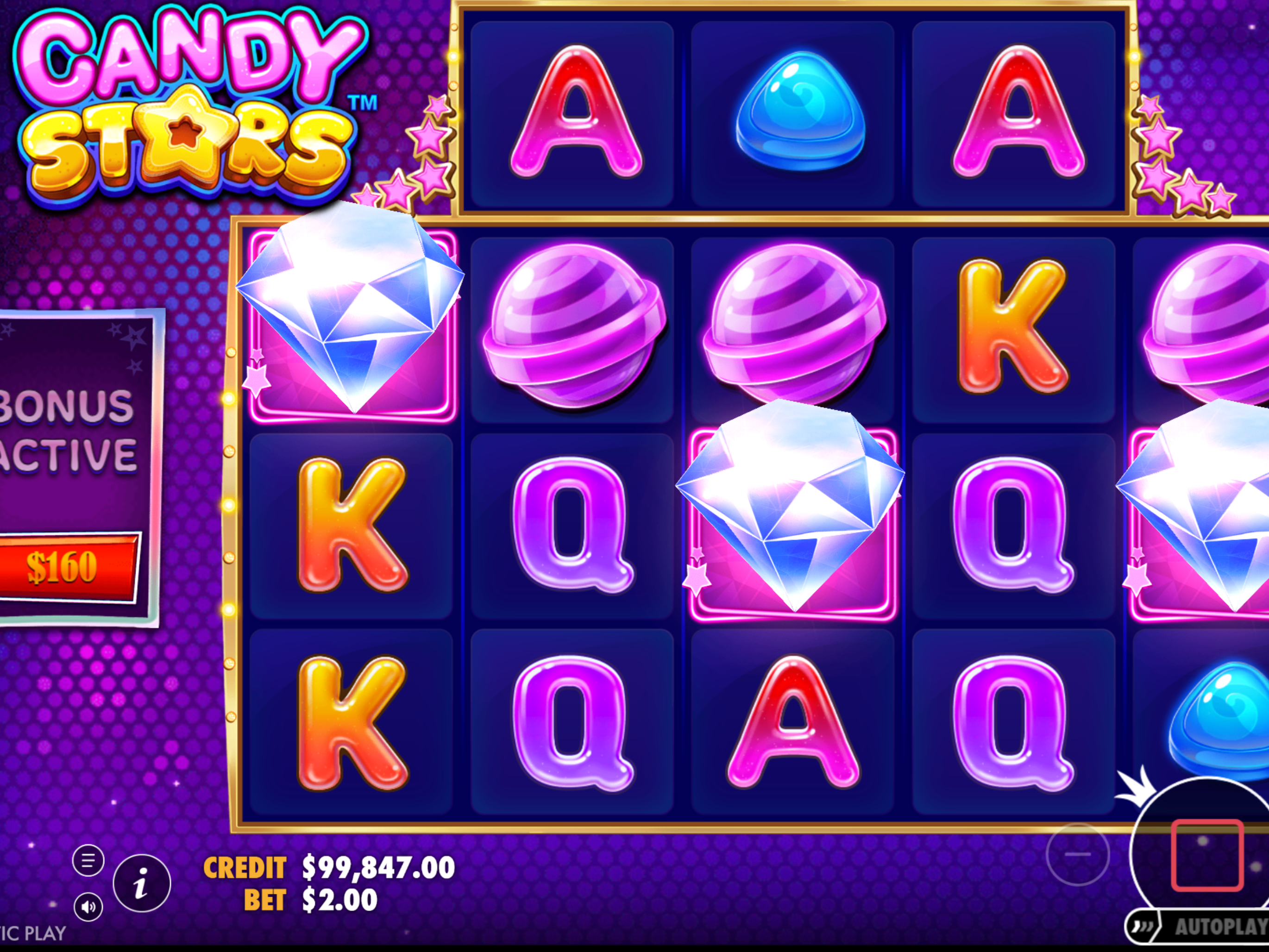
Candy Stars strategy tends to be discussed as if you can “steer” wins by timing spins or manipulating streaks. In practice, this Pragmatic Play slot operates like most modern tumble games: outcomes are determined by an RNG, while players mainly control risk exposure through configuration choices.
Does Candy Stars allow real strategy, or only risk adjustment?
Candy Stars does not offer strategic decision-making that can improve the mathematical expectation of a spin. There are no skill checks, no hold decisions, and no player choices inside the core outcome generation. What it does allow is risk adjustment: you can decide how much variance you are willing to take on per unit time and whether to access higher-variance features (if your version includes a feature buy).
A useful distinction is: decision influence versus outcome determination. In Candy Stars, you can influence:
- Stake size and therefore how quickly swings register in currency terms.
- Spin speed / autoplay settings, which affect pace, not odds.
- Feature access (in some jurisdictions/versions), which shifts volatility and payout distribution.
You cannot determine whether the next tumble connects, whether a multiplier lands, or whether free spins trigger. Those are generated independently of any prior sequence.
Two mechanics that create the “strategy illusion” in Candy Stars
Most versions of Candy Stars seen in casino lobbies are built around (1) a cluster-pay tumble system and (2) multipliers that apply to a tumble chain, with (3) a free spins bonus that changes multiplier behavior. If your paytable shows a different structure, treat this as a framework and defer to the in-game rules.
Candy Stars strategy and the tumble chain problem
Tumble mechanics create multi-stage rounds where a single paid cluster can remove symbols, drop new ones, and potentially pay again. This is where players often believe “reading the board” matters. It doesn’t, because each completed spin is already resolved by the game’s internal outcome generation before you see the animation. The tumble chain mainly affects distribution: a higher share of total value can arrive in fewer, more concentrated rounds compared with fixed-payline slots.
The practical implication for Candy Stars strategy is not “how to force longer cascades,” but understanding that results can look quiet for extended stretches and then compress multiple payouts into a short burst. That compression is variance, not a solvable pattern.
How multipliers reshape volatility in Candy Stars
Where Candy Stars becomes meaningfully different from a plain cluster slot is the multiplier layer. When multipliers can land during tumble sequences and apply to the total of that chain, the game’s payout profile becomes more top-heavy: more of the expected return is pushed into rarer, higher-magnitude events.
This matters because players sometimes misinterpret a run of small or zero outcomes as “the multiplier is due.” In reality, multiplier appearances are governed by their own probabilities. Your only real choice is whether you want to expose your balance to that lower-frequency, higher-impact part of the distribution or prefer a slower pace and smaller swings by adjusting stake and session speed.
Feature buy and bonus access: the only lever that truly changes risk
In markets where Pragmatic Play offers a feature buy on Candy Stars, it is the single configuration choice that most changes the risk profile. Buying a bonus typically concentrates play into high-variance bonus rounds at a fixed cost, reducing the role of long base-game stretches spent waiting for triggers.
That is not the same as “better value.” Depending on the specific RTP model and bonus pricing, a buy can be neutral, slightly worse, or (less commonly) slightly better in expected value. The key point for Candy Stars strategy is that a buy is primarily a variance switch, not a way to outsmart the game. If you want the mechanical rationale and round flow, see https://playstories.co/candy-stars-how-it-works/.
Common Candy Stars “strategies” that don’t hold up
Myth: After many dead spins, Candy Stars is about to pay
Dead stretches are consistent with a tumble slot where value is concentrated into multiplier-boosted chains and bonus events. The appearance of being “due” comes from human expectation of regularity, not from the RNG tracking droughts.
Myth: Changing bet size influences bonus timing
Adjusting the stake changes the amount at risk per spin, not the probability structure of the next outcome. Any “it hit right after I raised my bet” story is sampling noise.
Myth: Fast spins reduce payout quality
Turbo and autoplay change the presentation layer and pace. They do not imply a worse reel set or a different payout table. What they do change is exposure per minute, which can make variance feel harsher because swings arrive faster.
Realistic expectations: what Candy Stars strategy can and cannot do
A realistic Candy Stars strategy framing is: you manage how you experience variance, not whether you beat it. If you choose higher pace and bonus access, you are choosing faster exposure to the game’s high-variance tail. If you choose slower pace and smaller stake, you are choosing to smooth currency swings while accepting that the underlying randomness is unchanged.
That’s the practical boundary in Candy Stars: configuration affects risk and pacing, while outcomes remain probabilistic and externally fixed by the game design.
Leave a Reply