
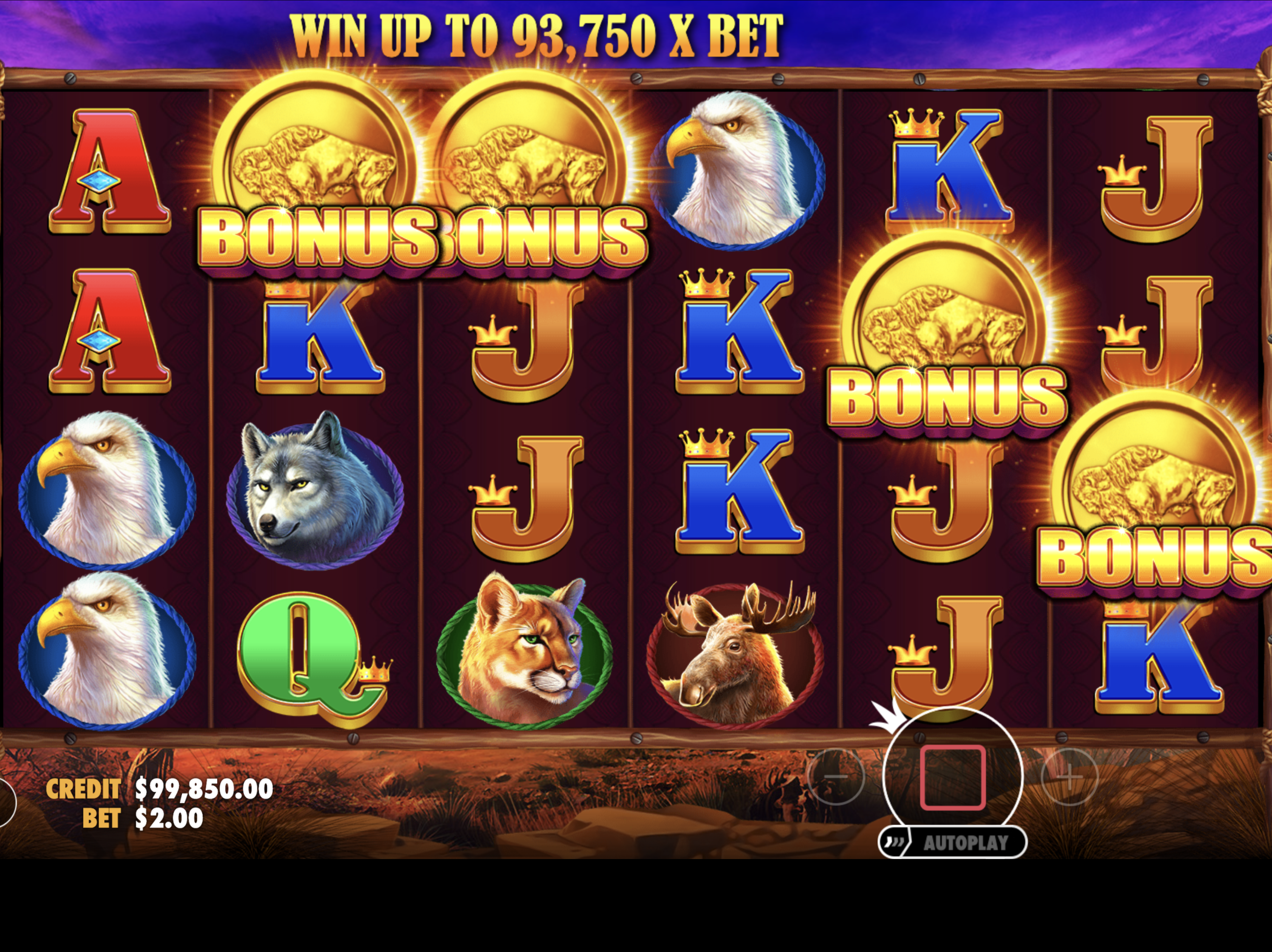
Buffalo King fairness concerns are common with high-volatility slots because outcomes can look “patterned” during long dry spells or sudden bonus streaks. The useful way to evaluate legitimacy is not by judging short sessions, but by understanding what the software is allowed to do, what it must do, and where evidence typically exists (or does not exist) for a specific title.
Buffalo King fairness starts with how the round is determined
Buffalo King (Pragmatic Play) is a standard RNG-based video slot. That matters because it sets expectations: each paid spin is a discrete event whose outcome is generated by a random-number generator (RNG) and then mapped to reel stops according to the game’s internal math model (virtual reels, symbol weighting, paylines, and feature logic).
In practical terms, a spin’s “result” is decided before you see the reels animate. The animation is a presentation of the already-determined outcome. This is one reason why visual cues (slowdown effects, near-misses, “almost” landing a scatter) are not reliable indicators of the game “trying” to do anything. They are simply a user interface layer showing an outcome the RNG has already produced.
For a title like Buffalo King, outcome determination typically includes:
- Base-game reel stops selected via RNG and mapped to configured reel strips.
- Payline evaluation based on the paytable and active lines.
- Feature triggers (for example, free spins) that occur only if the RNG-selected stop pattern meets the trigger condition.
- Bonus-round spin outcomes that are also RNG-driven on each bonus spin, rather than “scheduled” as a guaranteed arc.
This is the key point for legitimacy discussions: the game math is designed in advance, but it is not supposed to “adapt” to an individual player’s balance, prior losses, or bet size in real time. What can change legitimately is the expected distribution of results across many spins, because the math model may be volatile, with rare but larger wins.
Where Buffalo King fairness can be misread: streaks and feature timing
Many complaints about “rigging” are really complaints about variance. A volatile slot will produce long sequences of low or zero returns and then concentrate a meaningful portion of return into less frequent events, such as strong line hits inside free spins. That clustering is consistent with a fair RNG and does not, by itself, imply manipulation.
Another common misread is assuming that any “tease” (two scatters showing frequently without the third) demonstrates intent. In RNG terms, a near-miss is just another non-winning outcome that looks psychologically salient. It does not require a special “near-miss mode” for it to occur frequently in a 5-reel slot because there are many ways to land two scatters without landing three.
RNG vs “provably fair”: what Buffalo King does and does not offer
Buffalo King fairness is grounded in conventional casino-slot verification rather than “provably fair” cryptography. Provably fair systems (more common in some crypto-first games) allow a player to independently verify each outcome using server/client seeds and hashes. Buffalo King does not generally present that kind of per-spin public verification within the interface.
Instead, the standard model is:
- The provider implements an RNG and game logic that should meet jurisdictional technical standards.
- Independent test labs may review RNG behavior and game math to confirm statistical properties and adherence to the declared configuration.
- The operator’s platform records game events for dispute handling and audits.
This difference is important for transparency. With RNG slots, you typically assess Buffalo King fairness through process credibility (testing, certification, auditing, dispute trails), not through player-side cryptographic proof.
Transparency signals you can actually check (without guessing)
Players often look for a single “fairness indicator,” but in practice it is a patchwork. The most meaningful checks are observable artifacts around the game, not anecdotes about a hot or cold session.
1) Game information and RTP configuration. Pragmatic Play slots are commonly deployed in multiple RTP settings depending on the casino and jurisdiction. Seeing an RTP in the help/info panel is not a guarantee of your short-term experience, but it is a concrete disclosure worth comparing across casinos. If you want the deeper context of how RTP interacts with volatility and session outcomes, see the RTP-focused breakdown here: https://playstories.co/buffalo-king-rtp/.
2) Game history and round records. A legitimate platform should provide a bet/win history and be able to reference a round ID for disputes. This matters more than many realize because it is how unresolved outcomes are reconciled if there is a crash or disconnect mid-spin.
3) Disconnection handling and settlement rules. Buffalo King fairness is often questioned when a player disconnects during a feature. The standard expectation is that the round is settled server-side and the final result will be available when you reconnect or in history. If a casino cannot provide a completed record, that is an operator-level red flag, not proof that the game math is unfair.
Regulatory context: what “licensed and tested” usually means here
It is easy to overstate regulation. A more accurate framing is that regulated markets typically require technical standards for RNG gambling software and ongoing compliance checks. For example, the UK Gambling Commission publishes technical standards for remote gambling systems that cover areas like RNG expectations, game fairness, and recordkeeping (https://www.gamblingcommission.gov.uk/). Likewise, Malta’s regulator describes controls around gaming system audits and compliance expectations (https://www.mga.org.mt/).
Those references do not certify Buffalo King specifically. What they do show is the type of framework that, when applicable to the operator you are playing with, creates audit trails and consequences for non-compliance. If an operator is unlicensed or operating outside meaningful oversight, Buffalo King fairness becomes harder to evaluate because you lose the strongest transparency mechanisms: enforceable standards, testing requirements, and dispute escalation routes.
A measured bottom line on Buffalo King fairness
On the evidence-based side, Buffalo King is best understood as an RNG slot where each spin and each bonus spin should be independently determined according to a fixed, pre-approved math model. The main reasons it can feel illegitimate are normal variance, attention-grabbing near-miss visuals, and confusion around RTP configurations across different casinos.
If you want a practical fairness check, prioritize operator transparency (round history, clear RTP display, documented settlement after disconnects, and a recognizable licensing footprint) over trying to infer intent from streaks. That approach does not claim guaranteed fairness, but it does align with the mechanisms that are designed to make unfair operation detectable and contestable.
Leave a Reply