
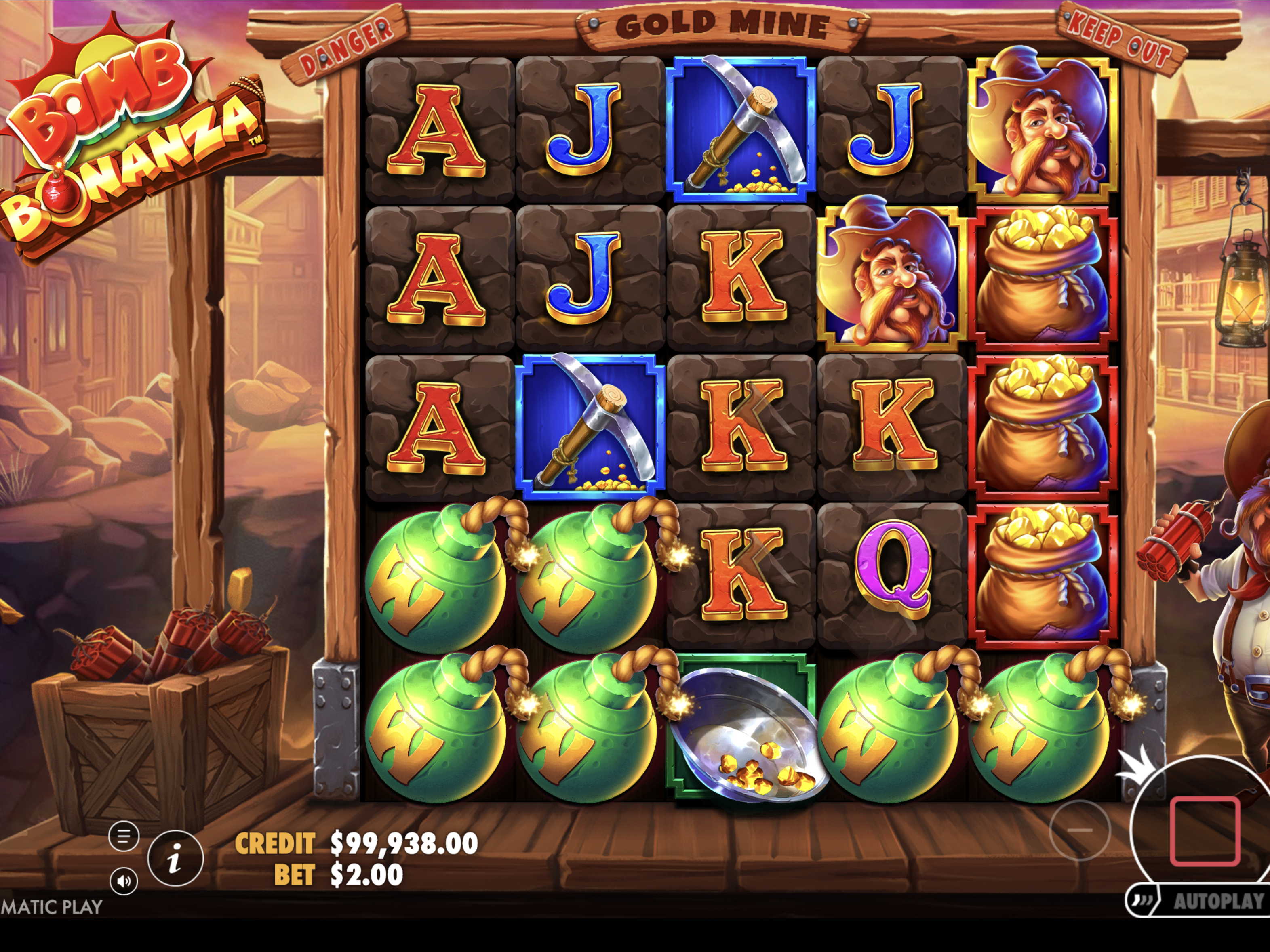
Bomb Bonanza is Pragmatic Play’s take on the mines-style “pick-and-cashout” format, where each selection either advances the round or ends it immediately. What makes this type of game distinct is that outcomes are not paced by reels or paylines. Instead, the design is built around a rising multiplier curve that rewards staying in the round, while a single losing reveal wipes the current run.
Bomb Bonanza round structure: one decision loop, escalating exposure
Each round begins with the player committing a stake and selecting a risk configuration (in mines-style games this typically means choosing how many hazards are hidden). The round then becomes a repeated decision loop:
- You choose a covered position to reveal.
- If it is safe, your “potential cashout” increases and you can choose to continue or stop.
- If it contains a bomb, the round ends and the stake for that round is lost.
Structurally, that loop is the whole product. The game’s tension comes from how quickly the cashout value grows relative to the chance of hitting a bomb as more positions are revealed. The practical implication is that two sessions can feel very different even with identical stake sizes because variance is driven by decision depth (how long you keep pressing) rather than by “spins per hour.”
Where the multiplier comes from (and why it rises nonlinearly)
In Bomb Bonanza, the multiplier is tied to how many safe reveals you have already made under the chosen risk configuration. Conceptually, the payout curve is doing two jobs at once: it compensates you for surviving additional draws, and it prices in the increasing fragility of the round. As fewer safe positions remain, the probability that the next pick hits a bomb rises, so the offered cashout needs to rise as well.
In most mines implementations, this produces a multiplier curve that accelerates as the round progresses rather than increasing in perfectly even steps. That acceleration is not “extra generosity” late in the round. It is the interface’s way of showing that you are accepting a rapidly worsening risk profile with each additional reveal.
Bomb Bonanza and the cashout decision point
The cashout option is not a bonus feature appended to a slot. It is the primary settlement mechanism. Each safe reveal updates the maximum you can lock in, and pressing cashout converts that displayed value into the round result. In behavioral terms, players often perceive a cashout as “taking profit,” but structurally it is simply choosing a stopping time on a defined risk curve.
This is also why strategy discussions for Bomb Bonanza tend to focus less on pattern-picking and more on setting exit rules. If you want a deeper look at how those decision rules interact with volatility, see https://playstories.co/bomb-bonanza-strategy/.
How outcomes are determined: pre-commitment vs reveal pacing
A common point of confusion in mines games is whether the bombs are placed “as you click.” In regulated RNG products, the typical model is that the round’s outcome is determined by a random process that is independent of the player’s mouse timing, and the reveals merely disclose that outcome step by step. In other words, the interface creates a paced discovery of information, but timing itself is not expected to be a controllable edge.
High level, that means two important things for how Bomb Bonanza works:
- Click speed and “hesitation” are not reliable levers for changing results.
- The only meaningful control the player has is risk selection and when to cash out.
For background on how RNG-based casino outcomes are commonly structured and audited, eCOGRA’s overview of testing and certification provides useful context: https://www.ecogra.org/certification/
Volatility behavior in Bomb Bonanza is choice-driven
Bomb Bonanza tends to feel more “swingy” than many low-to-mid volatility slots because losses can cluster when a round ends early, while wins are often gated behind multiple successful reveals and a disciplined stop. Two levers shape volatility at the session level:
- Risk configuration: more hidden bombs generally means higher potential multipliers but a narrower path to reaching them.
- Reveal depth: continuing for one more pick is effectively increasing the round’s variance, even if your stake never changes.
That second lever matters because it means two players can choose the same bomb count and still experience different volatility depending on whether they regularly cash out early or repeatedly chase deeper multipliers.
What the UI can and cannot tell you
The interface elements in Bomb Bonanza, such as current potential cashout and the number of safe reveals completed, are accounting tools, not predictors. Game history can help you verify that rounds are resolving and settling correctly, but it does not create an exploitable pattern because each round is designed to be independent. The most useful “information” on screen is therefore not past results, but your current exposure: how much value you have locked in versus what you are risking by taking another reveal.
Seen this way, Bomb Bonanza is best understood as a structured risk staircase. The game works by offering an explicit price (the cashout multiplier) for each additional step, while keeping the loss condition simple and absolute: one bomb ends the round.
Leave a Reply